There’s a slightly awkward question you should probably ask any company that sells technology solutions:
“Do you actually use this stuff yourselves?”
Fair question.
If we’re telling businesses that disconnected systems, manual processes and information trapped in different platforms are slowing them down, we’d be pretty hypocritical if we were running Mutherboard on a collection of spreadsheets, sticky notes and crossed fingers.
So we thought we’d open the cupboard.
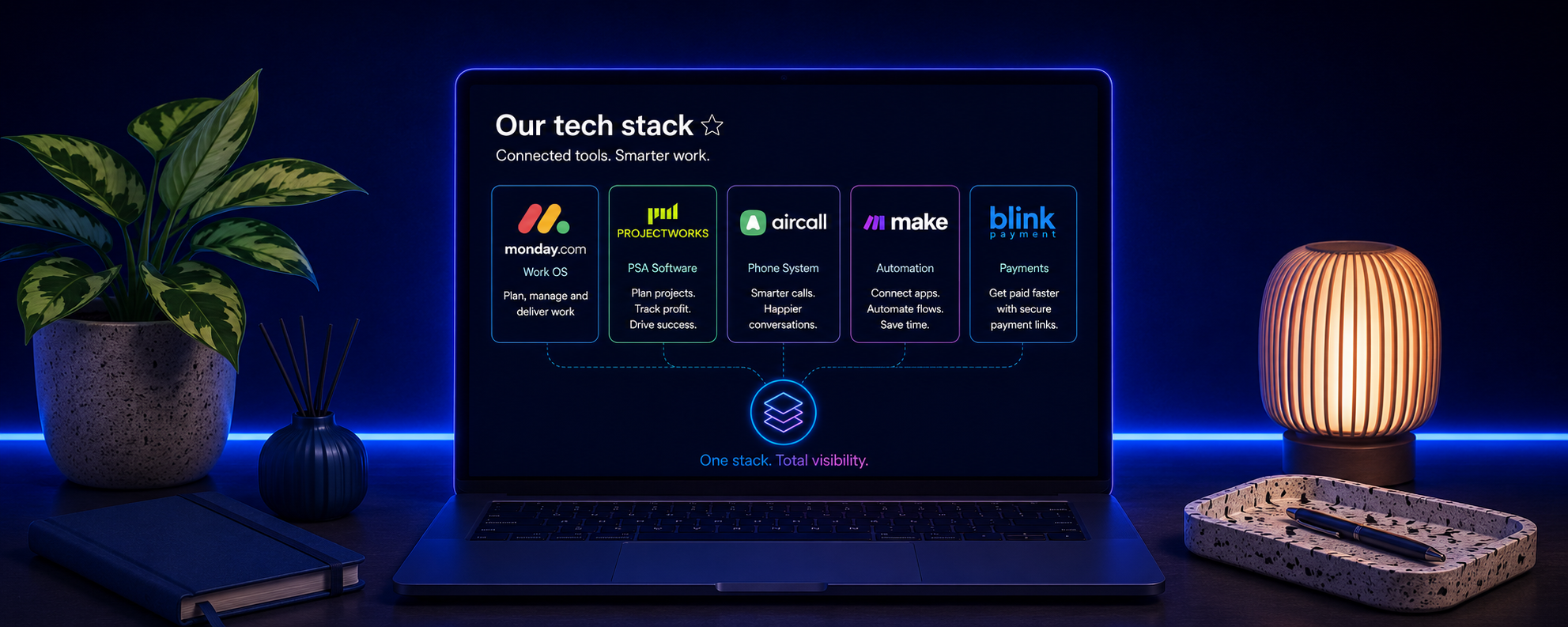
Here’s a look at how we run our own tech stack — and, more importantly, how we make all the different pieces work together.
We don't believe in having more tools. We believe in better-connected tools.
It’s easy to fall into the “we need another platform” trap.
A problem appears.
Someone finds a tool that promises to solve it.
You sign up.
Then another problem appears, so you find another tool.
Before long, you’ve got a technology stack that looks impressive on paper but feels like a group project where nobody has spoken to each other.
The problem isn’t necessarily the tools.
It’s the gaps between them.
When your CRM doesn’t talk to your project management system, when your project data doesn’t feed into resource planning, or when someone has to manually move information from one platform to another, you create friction.
And friction adds up.
So what does Mutherboard actually use?
We use a combination of platforms to manage different parts of the business — from projects and resources to communication, customer relationships and automation.
But the interesting part isn’t really the individual tools.
It’s what happens between them.
We’ve built integrations and automated workflows that allow information to move between systems without someone having to copy, paste, check, update and repeat the same task every five minutes.
Because if a computer can do it reliably, why are we making a human do it manually?
That’s the kind of question we ask ourselves constantly.
Our own business is the test environment
One of the advantages of building solutions for other businesses is that we’re constantly exposed to different challenges.
But there’s another advantage:
We get to test our ideas on ourselves first.
If we can find a better way to manage a process internally, there’s a good chance that the thinking can be applied elsewhere.
If an integration saves our team time, removes duplication or gives us better visibility, we learn from it.
And if something doesn't work?
Well… that's useful too.
You learn pretty quickly that automating a bad process doesn't magically make it a good process.
It just makes the bad process happen faster.
Automation should remove the boring stuff
We’re big believers in automation, but not automation for automation’s sake.
The goal isn't to build a ridiculously complicated machine just so we can say we built one.
The goal is pretty simple:
Let technology handle the repetitive work so people can focus on work that actually needs people.
That might mean automatically moving information between systems.
It might mean triggering an action when something changes.
It might mean using AI to help analyse information or speed up a task.
Or it might mean simply removing a five-step manual process that nobody enjoys doing.
Those little improvements can make a surprisingly big difference.
And then there’s AI…
AI has obviously changed the conversation around technology.
Suddenly, every business is asking:
Where can we use AI?
But we think there’s a more useful question:
“Where would AI actually make this process better?”
Because adding AI to a messy workflow doesn't fix the underlying mess.
Before you start asking AI to optimise everything, you need to know what your processes actually are, where your data lives and how your systems communicate.
In other words:
Good AI starts with good systems.
That’s something we’re particularly interested in at Mutherboard — finding practical ways to combine integrations, automation and AI without losing sight of the people actually using the systems.
We’re still figuring it out
And this is probably the most important part.
Our tech stack isn't some finished masterpiece that sits untouched in a glass case.
Businesses change.
Teams change.
Technology changes.
Our own needs change.
So our systems have to change too.
We’re constantly looking for ways to remove friction, improve visibility and make the business easier to run.
Sometimes that means adding something new.
Quite often, it means taking something away.
And occasionally it means looking at a process we've been doing for months and asking:
“Why on earth are we doing this manually?”
That question has probably saved us more time than any shiny new piece of software.
Because if we're going to tell businesses to build better-connected systems, we think it's only fair to show you how we're trying to do the same thing ourselves.
Build it. Use it. Improve it. Repeat.
That’s the real tech stack.