Most leaders believe metrics help them understand performance.
What many overlook is that metrics do something far more powerful.
They shape behaviour.
Every number that appears on a dashboard sends a signal to the organisation about what matters. People naturally optimise for whatever is measured, rewarded, and discussed. That is why choosing the wrong metrics can quietly create the very problems leaders are trying to solve.
A team that is measured by the number of meetings attended will attend more meetings.
A team that is measured by the number of tasks completed will focus on completing tasks.
A team that is measured by response times will prioritise speed.
None of these are necessarily bad. The problem arises when activity becomes confused with impact.
Many organisations fall into the trap of tracking vanity metrics. These are numbers that look impressive in reports but have little connection to meaningful business outcomes. They create the illusion of progress while masking inefficiency.
This is particularly relevant in today's workplace.
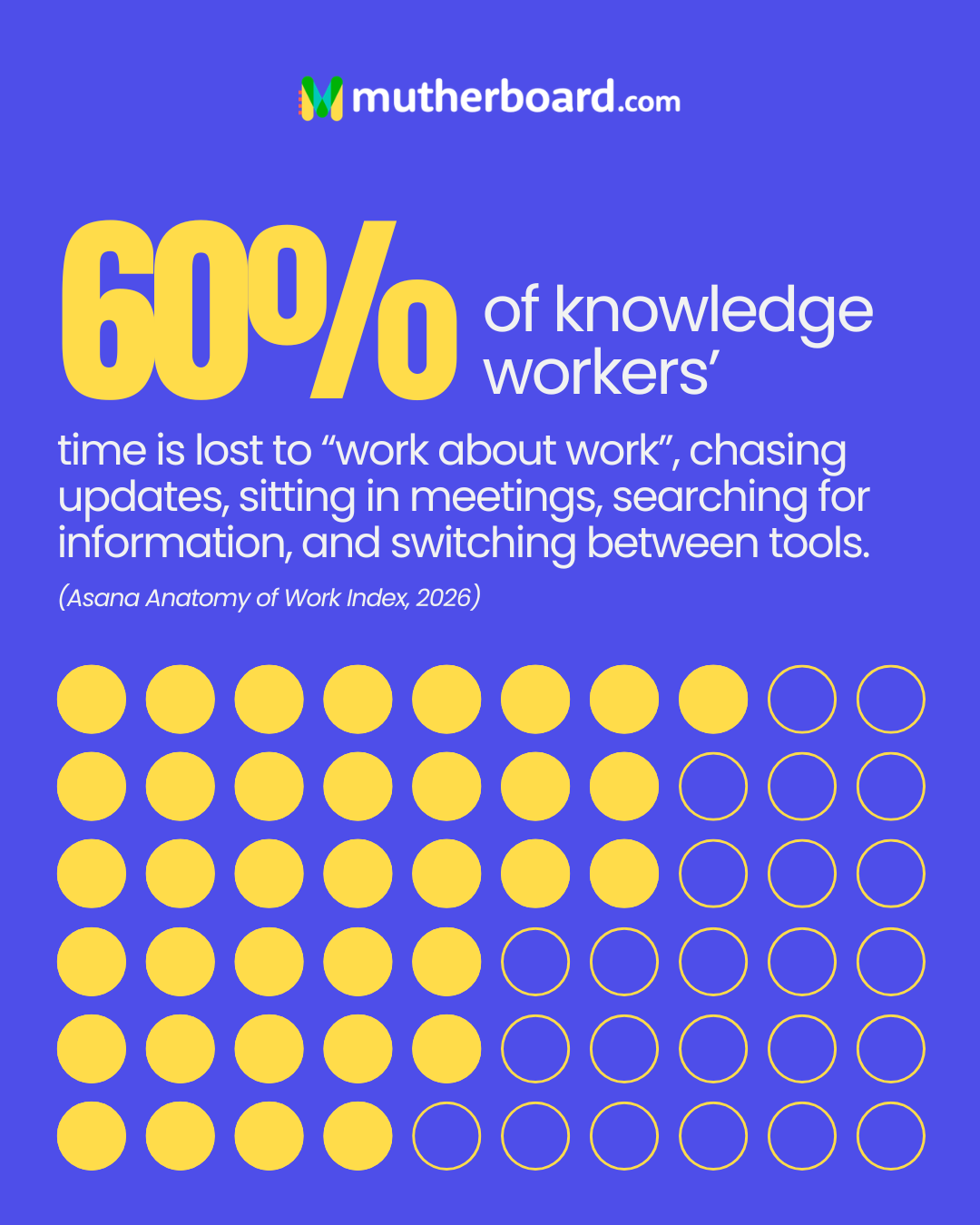
According to Asana's Anatomy of Work Index, knowledge workers lose 60% of their time to what Asana calls "work about work". This includes chasing updates, searching for information, attending status meetings, switching between tools, and coordinating with colleagues.
These activities are often the by-product of systems designed to measure and monitor work rather than enable it.
The result is a paradox. Teams appear busy, dashboards are full of activity, yet execution slows down.
The distinction leaders need to make is between activity metrics and outcome metrics.
Activity metrics tell you what people are doing.
Examples include:
- Number of meetings attended
- Emails sent
- Tasks completed
- Hours worked
- Reports submitted
Outcome metrics tell you what people are achieving.
Examples include:
- Revenue generated
- Customer satisfaction
- Project delivery speed
- Customer retention
- Reduction in operational costs
- Strategic objectives achieved
Both types of metrics have their place. Activity metrics can provide useful operational visibility. The danger comes when they become the primary measure of success.
If employees know they are being judged on activity, they will naturally increase activity. More updates. More meetings. More reporting. More administration.
If employees know they are being judged on outcomes, they will focus on delivering results.
That shift changes how organisations operate.
Leaders often ask why teams seem overloaded despite investments in technology, process improvements, and productivity tools. In many cases, the answer is hidden in the metrics themselves.
The organisation is measuring effort instead of impact.
Before introducing another KPI, dashboard, or reporting requirement, it is worth asking a simple question:
Does this metric help us improve execution, or does it simply tell us that people are busy?
The most effective organisations are ruthless about reducing unnecessary work. They eliminate friction, simplify communication, and ensure their metrics reinforce the behaviours that create value.
Because metrics are never neutral.
They influence decisions.
They drive priorities.
They shape culture.
And ultimately, they determine whether people spend their time doing work or working about work.
If you want better outcomes, start by reviewing what you're measuring. The fastest way to change behaviour is often not through new processes or new tools, but through better metrics.